February 25, 2026
Disabled And Here Illustrator: Interview with Liz
Hi! How would you like to introduce yourself?
I’m Liz. I’m a queer, East Asian, abolitionist socialist artist new-ish to experiencing chronic pain. I was born with a cleft lip and palate and transracially adopted from Korea. I love watching kids’ cartoons and coming home to my cat.
A lot of your work is, as you describe in your Instagram bio, “rooted in collective struggle and liberation.” How did you get started in this path and with illustration and infographics in general?
Content warning: discussion of police brutality
I’m ideally in constant and active dialogue with myself and others about what collective struggle and liberation means and how we get there. This began relatively late for me, when I was in graduate school and watched the video of the cop killers murdering Eric Garner. I started looking for anything and anyone that would help me understand and I continue on this non-linear path today.
Shortly before the pandemic started, I began creating visual notes. My partner also generously gifted me an iPad, and I began drawing consistently again for the first time since college. I posted my notes and drawings online and they got some attention. Once we were in lockdown, people and organizations began to ask me to create images based off of virtual events. For the past several years, I have continued creating infographics based on things I am learning about and in relation to my varying capacities, depression levels, and pain levels.
Is there a dream project or collaboration you’d love to take on someday?
This has honestly been a dream project for me, even if I didn’t know it before starting. 2025 was a year for me to finally start to be in relationship with my body, as it was crying out in pain after I spent so many years hunched over electronics. While I have been invested in disability justice as someone who is post- and pre-disabled, I have been slowly unpacking my own ableism to start identifying as currently disabled.
This collaboration with Elea [Affect creator] has been my first time intentionally incorporating my disabilities into my art. Elea was communicative and encouraging, offering many insights along the way, including gently pointing out ways my illustration was leaning into ableist tropes and supporting me to challenge myself in new ways. This was a dream project because I learned about myself through the process and was able to grow from it (and get paid to afford rent! Pay artists!).
When you just need a break, what are some things that help recharge you or bring you joy?
Children’s cartoons bring me so much joy. During the pandemic, I started watching so many cartoons and grew closer to a friend who also loves cartoons. Some of my favorites are Bee and Puppycat, Kipo and the Age of Wonderbeasts, The Owl House, Kotaro Lives Alone, and Steven Universe.
I also love water. Seeing a body of water, like a pond or the ocean, or being in water whether a shower or swimming, helps my body feel grounded and my mind more centered.
Can you do a bit of world-building for the illustration you created for our Disabled And Here: Possible Futures series?
I imagine this world to be closer to a liberatory horizon that embodies disability wisdom and abolition infused with solarpunk aesthetics. In this world, interdependence is the life force around which society is based, rather than extraction and dispossession.
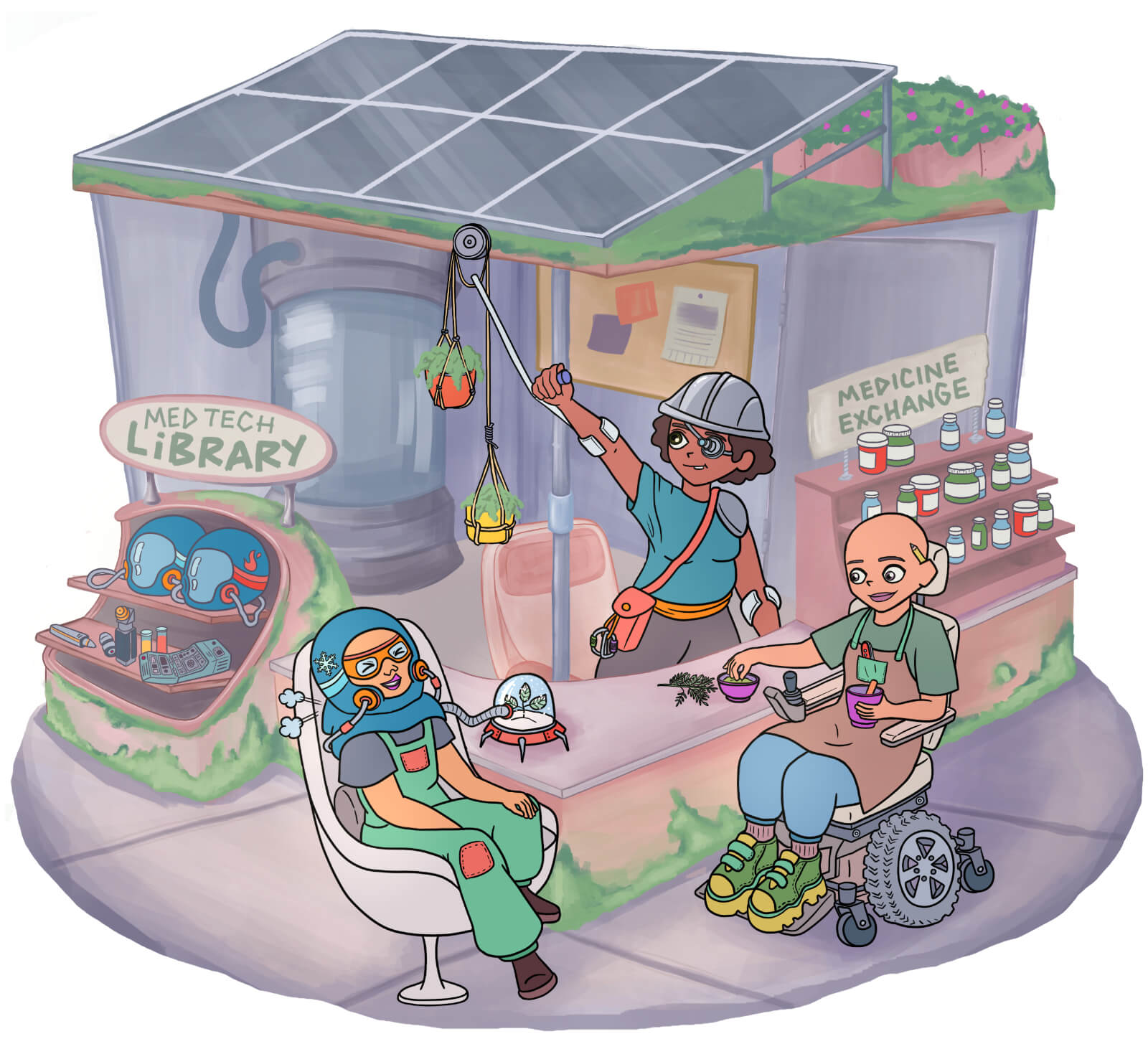
I chose to draw an apothecary stall because I wanted to depict a healthcare economy based on mutual care rather than the medical industrial complex as we know it today. The people in the image show up as they are able to and as they need to — whether that means taking care of their own bodies or of others.
The person in the cold cap is experiencing a pain flare and so they are using the cap for pain relief. The person in the power chair is a medicinal healer, making medicine out of the plants grown at the apothecary. The medicine will then be added to the medicine exchange for distribution. The person behind the stall is a techie who maintains the med tech library. They are using their forearm crutch to grab a plant for the medicinal healer. Their stories are immense and complex, but this is a small glimpse of a quiet moment in this world.
As you know, this series is dedicated in memory of Alice Wong, and you’re one of the illustrators she worked with. Did you draw any inspiration from her for the illustration?
I only had the opportunity to work with Alice on two occasions, and they were both memorable. The bacta tank from Star Wars is a specific homage to Alice and one of the first conversations we ever had where we bonded over our love for sci-fi.
More broadly, I am still learning and internalizing Alice’s expansive understanding of disability as abundance; as time travel; as a portal to new worlds. I think these new worlds are within us and Alice’s words and way of being encourages me to tap into them rather than shut them down or distract myself from them. She taught me to listen to them and embrace them. To love them. To love each other and ourselves and fight.
In the vein of imagination, if there were a more magical universe, what kind of superpower would you want most?
I wish I could communicate with people in whatever their language is.
Final question: what are the best ways to support you and your work going forward?
Please consider giving monies to my friend’s cancer fund! Otherwise, you can find my work on IG at @Lizar_tistry.