November 19, 2026
Affect the Nonprofit: Questions, Answers, and Possible Futures
What has Affect been working on recently?
Lately, we’ve been super focused on the COVID + Health Resource Library (CHRL) and planning its pop-ups. We now have a new self-service CHRL hub at openHAUS Coworking, which gives disabled BIPOC around Northeast Portland a place to stop by and grab free masks, plus a home for our own future pop-ups / monthly hours, where people can drop in to check out tools from the library. We also released the Disabled And Here Possible Futures series (in memory of Alice Wong) back in Spring.
Earlier in the year, we were sidelined for months from suddenly losing fiscal sponsorship and having to emergency incorporate. BUT, that means Affect the Verb is our very own nonprofit now!
Why did Affect originally choose fiscal sponsorship? What changed?
Creating your own nonprofit is a great idea IF you have funding, people, and/or some sort of guaranteed stability for the next five years. For most of Affect’s existence, we haven’t been sure that we were going to make it into the next year and I have been the sole day-to-day person doing things. And the reality of being a multiply disabled person and a chronically ill person is that your capacity is not guaranteed. I went for fiscal sponsorship because I wanted to funnel the energy I have into programming work, rather than the operations and management side. Fiscal sponsorship is supposed to help alleviate all that, because finances and a lot of administration work are handled by an overarching 501(c)(3) nonprofit in exchange for a fee that you pay — typically between 5-10%.
The downside of that is that your experience will vary heavily depending on the structure of your fiscal sponsor. A lot of the nonprofits doing this work are underresourced, which leads to things not being the most organized or consistent.
Can you walk us through the process of becoming a nonprofit? What surprised you? What support did you need?
Because we’re in the times that we’re in, I hired legal counsel to help us with nonprofit incorporation. It’s pretty similar to when I applied for [U.S.] citizenship, in that you don’t technically need a lawyer and could actually do all the paperwork and preparation yourself, but I wanted to be sure that we didn’t make any mistakes.
There’s a lot of steps involved. Assuming you already have some sort of business plan in place, you have to put together a board that’s willing to take on the legal responsibility of overseeing your nonprofit, appoint officers, file with the state, wait for state approval, file federally (which can be super complicated depending the scope of your nonprofit — ours was simpler because we qualified for the streamlined / fast-tracked nonprofit application), and file with the Oregon Department of Justice. Beyond that, there’s a lot of administrative work, like opening up a bank account, buying insurance coverage, creating bylaws for the nonprofit, etc.
We initially thought that we would need a temporary fiscal sponsor to help us bridge the gap between us filing paperwork and getting 501c3 (nonprofit) status, but the streamlined application was approved fast enough that we were able to skip that step.
In our case, we also had to coordinate with grantors, because we had two grants that needed to be transferred, but I’m super thankful that the foundations were hugely supportive and great to work with.
How has becoming a nonprofit / having a board changed how Affect operates? What’s different day-to-day versus more broadly?
We really experienced firsthand why nonprofits require a whole staff to run beautifully! We don’t have enough money to hire actual full-time or even part-time staff, so we rely on contractors and partners to help with things — I didn’t fully realize before that nonprofit operations can be a neverending rabbit hole of tasks and responsibilities.
We’ve put a lot of effort into finding partners who are more community-centered. For instance, we chose a credit union over a bank, but most credit unions require two board members to appear in person during weekday business hours to fill out paperwork, telling us that it’s a practice to prevent fraud. When we think about how quickly credit unions and banks were able to switch to digital asynchronous systems during COVID lockdowns, though, these requirements can feel like they’re not so much preventing fraud as preventing people with limited spoons from accomplishing the tasks necessary to run an organization. It’s part of a larger sense that decision makers are more obsessed with preventing people from getting help in the name of stopping bad actors, instead of ensuring the people who need the services get them.
Who did you prioritize getting on the new board?
We already had an Advisory Council in place that I put together last year, and they thankfully agreed to become board members. I also recruited one new board member, so Affect has a four-person board. All of our board members are disabled people of color and we’re queer and trans-led too.
The advisory council was already doing essentially the same work that the board does. They both set Affect’s operational direction. But they’re legally different. An advisory council has no legal or fiduciary responsibilities and weirdly, that means you’re allowed to pay them. Oregon in particular is very strict about board members being volunteers, which to me speaks to how the system was built to maintain inequity and a certain class of people serving in these positions.
For Affect, it’s extremely important that we are disabled, queer, and BIPOC-led, because that’s who our organization is for. I think a nominal stipend should be a thing that’s legally allowed nationwide, to disrupt the nonprofit industrial complex and pave the way for more community work to be led by the actual members of said community, who have lived experiences and deeply understand our own wants, needs, and systemic neglect. A lot of people think of leadership as just an executive team, but leadership means who’s at the very top of the hierarchy, making the most important decisions, and that includes nonprofit boards as well.
We’ve heard a lot about more scrutiny for nonprofits in the DEI space in the last few years — did that cause any problems for you?
A lot of nonprofits and even grantors have talked about how funding has dried up in the last year, and we’ve definitely felt that shift as well. Organizers have told us about having to update their language and how they talk about their mission and programs in order to stay in existence.
These changes have led us to think more about our communities and partners, and how we build connections that will sustain us through this period. To be a truly good community organizer, you have to build genuine relationships within your community. You can’t be transactional, and instead have to be genuinely interested in what’s going on with people in your space. You have to build in time where there’s no specific agenda, when you can chat informally and find out about experiences that don’t fit nicely into community engagement forms. You have to care about people.
That doesn’t mean that you have to like every single person. In fact, it makes no sense to love everyone when a lot of people are invested in systems that can cause you harm or even death. You have to get to know people on a personal level to find out if they actively share your values, rather than looking at any mission or vision statement. You have to see how people move and what they do.
Affect’s experiences with different fiscal sponsorships really made this clear for us too. More than one fiscal sponsor’s operations looked very different from what their websites and other materials suggested. We only learned what each organization was like through direct onboarding and day-to-day communication. Even with meetings and beforehand, you typically won’t know what a fiscal sponsor is like until you’ve already signed the contract, much like interviewing for a job versus working the job.
Are there any red flags that would warn you off a potential fiscal sponsor now? What about signs of a fiscal sponsor that would make you want to work with them?
Finding a fiscal sponsor is kind of similar to finding a partner – there’s no perfect fiscal sponsor, and it’s unreasonable to expect perfection, but you have to find an organization whose gaps mesh together with your organization’s gaps. Between the two of you, you want to form a functional and healthy enough organizational being. People joke about how you pass around one brain cell; here, you’re coming together to form one semi-functioning non-profit amoeba-thing. You want to be a force for good, but everyone’s underresourced, so together you can share your resources and stretch them further to do your work. It’s hard to do good and even harder to do good effectively. It’s like building a boat with duct tape. You only have half a roll, you want to find a fiscal sponsor with half a roll, and then you can make one duct tape ship. But sometimes they say they have half a roll, and they only have a third. It doesn’t always come together and then you hope you can tread water together.
Unfortunately, you can’t look through an organization’s duct tape supply before you start working together. Most of the time, you can’t even easily tell who else they’re sharing duct tape with. Very few fiscal sponsors keep their pages up to date with current fiscal sponsorees. We’ve seen fiscally sponsored projects choose to be more anonymous because their information isn’t safe to publicly share in the current political climate. The lack of information about fiscally sponsored projects makes it harder to judge the fiscal sponsor’s capacity.
Some signs that a fiscal sponsor may be a good partner:
- There’s more than one person doing operations tasks
- They have plans for points of failure (like if the main operations person is out for an extended period of time)
- They have systems in place for work that happens regularly, like instructions on who to communicate with when requesting payments or reimbursements and who to reach out to for grant signatures
- They use tools that signal they have some resources and experience in the space (donation platforms are a good example; an organization relying on PayPal and Square to accept funds is more likely to be underresourced and inexperienced than if they use GiveButter, DonorBox, and other purpose-built donation tools)
- The leadership team reflects the community they serve rather than reinforcing white supremacist patriarchy
How did Alice Wong inspire the Disabled And Here Possible Futures series?
It’s been about a year since we lost Alice?! I’m still cycling between mad and sad. She was both a friend personally and a beacon publicly — an activist who made so many people feel that better futures are not only deserved, but absolutely possible. Her legacy inspired our speculative Disabled and Here illustration series, both because of the stories she enjoyed and because disabled people are so rarely depicted in science fiction and fantasy.
The series was a response to our grief, but also our hope. When I look at Ty’s illustration, for example, I felt like Ty depicted a world and future worth existing in, where we can just have good things.
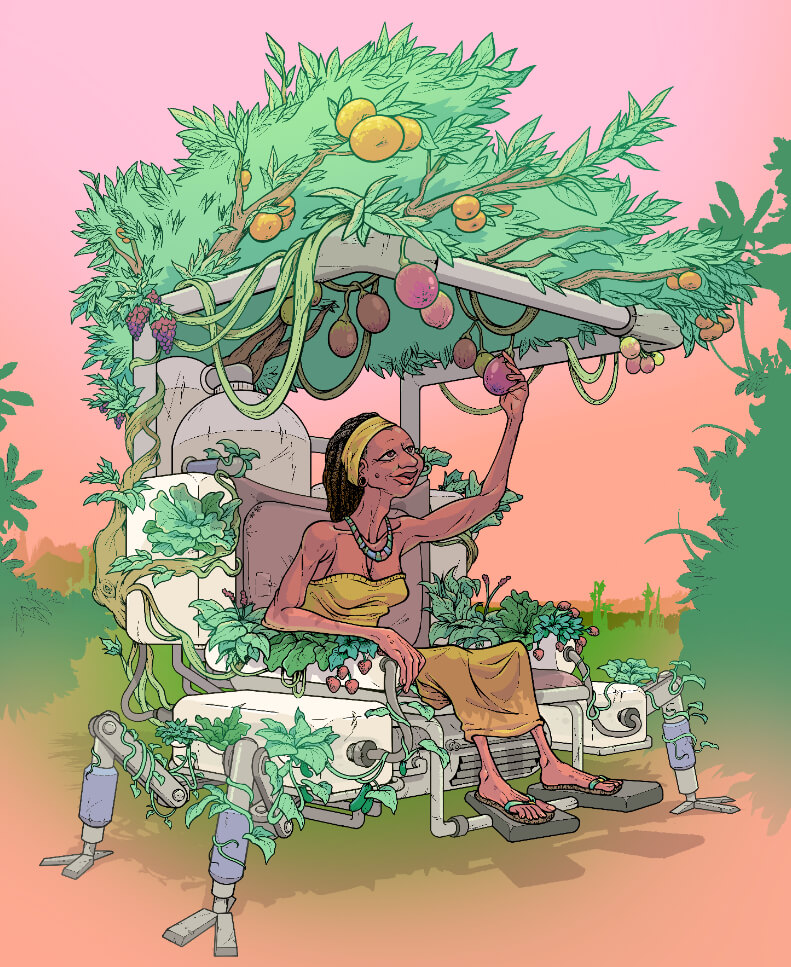
We spend too much space and time as community organizers fighting metaphorical fires and addressing community crises. We don’t get to spend enough time imagining great outcomes. Sometimes, here and now, we have to settle for the smallest crumb. But this series is a push to dream big. What will our world look like if we own the whole bakery, rather than a crumb here or there? I think Alice would want us to have the joy of thinking about these kinds of lovely futures and our Disabled and Here tribute series is an effort to do just that.
What’s the priority for Affect moving for the end of 2026 and 2027?
It’s been a tough year, not just for us, but for a lot of people, whether medically, emotionally, or professionally. Everyone I’ve talked to is just so TIRED and going through crisis after crisis. We’re trying to prioritize and practice sustainability. But we’re also looking for ways to carve out more space for disabled joy and imagination. As Mariame Kaba says, "Hope is a discipline," and it’s one that we hope to cultivate more in 2027.
That work is some of the most difficult we do at Affect. In a lot of ways, working on a project like CHRL is easy: we can see the resources our community needs and just have to find ways to supply those resources. We have plans for growing the library as well as creating more spaces for this kind of community care.
Disabled and Here, however, requires hope and imagination. It’s a type of emotional and mental labor that I struggled with at various points of 2026, making it harder to come up with the next Disabled and Here series. But it’s a crucial part of Affect’s work. Looking at beautiful things makes you feel good, even in mundane moments. Really great art can give you the will to go on. It can light a little fire in you or make you feel seen. As we plan for a new Disabled and Here series in 2027, we’re thinking about what feels radical and fun, celebratory and a little defiant. We are counterprogramming against the public narrative and centering disabled humans in their fullness and complexity, rejecting cliched disability tropes of tragedy or inspiration porn, and leaning hard into disabled joy and creativity.
We need reminders that there are good things in the world and we can create more of those things. And while we practice hope and work towards something better, we will continue to care for our communities by providing some necessary resources for survival, so we can help free up some of disabled folks’ mental capacity and wallets, and people can still be equipped with personal protective equipment in the ongoing COVID pandemic and flu seasons.
How can we support Affect moving forward?
There are three key ways to support Affect right now. The first is to donate money; at the moment, we need about $3-5k to make sure our programs and the nonprofit as a whole can be sustained through the second half of 2027.
We’re also recruiting for a board treasurer or a board officer who might be good at fundraising. If you’re a disabled person of color in Oregon who’s good with numbers and comfortable supervising our bookkeeper, or you’re well-connected with businesses and organizations, please reach out or keep an eye out on our website sometime in February.
Lastly, using the resources we offer is a great way to support us, whether or not you’re able to sit on the board or make a donation. Affect will continue having CHRL pop-ups and Disabled And Here shoots in the new year, so consider answering a future call for participants or just stopping by an event!